

WAKAW — Sept. 30 marks the National Day for Truth and Reconciliation, a day established by the Canadian government in 2021 to honour survivors of residential schools and those who never returned home from them.
The declaration of the day was a direct response to Call to Action 80 from the Truth and Reconciliation Commission’s final report, listing 94 Calls to Action: “We call upon the federal government, in collaboration with Aboriginal peoples, to establish, as a statutory holiday, a National Day for Truth and Reconciliation to honour Survivors, their families, and communities, and ensure that public commemoration of the history and legacy of residential schools remains a vital component of the reconciliation process.”
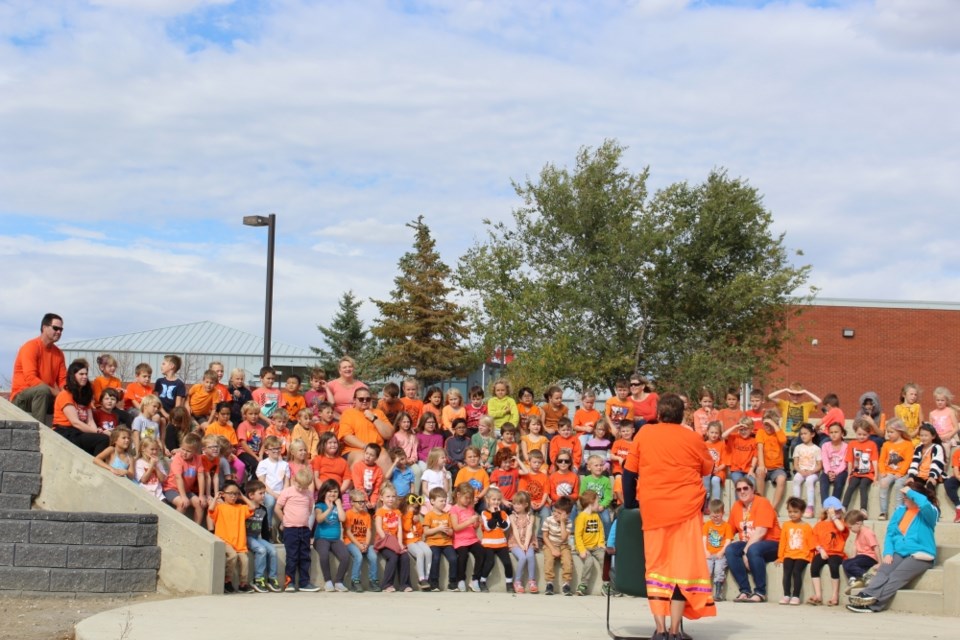
Orange Shirt Day is also observed on Sept. 30 each year, and it holds an equally significant meaning.
Phyllis Webstad, the founder of Orange Shirt Day, wants Canadians to remember that this day came about as a way to honour the experiences of Indigenous peoples affected by the residential school system. In 2013, a few months after a commemoration event for residential schools in Williams Lake, she encouraged people to wear orange shirts in future years. Phyllis’s brand-new orange shirt was taken from her when she first arrived at Residential School and was never returned. The orange shirt is representative of all that was taken from Indigenous students by the Residential School system.
Orange Shirt Day is an Indigenous-led grassroots initiative aimed at raising awareness of the impacts of the Residential School System in Canada. It is often mistaken for just another part of the National Day for Truth and Reconciliation, even though it pre-dated it by eight years.
Sept. 30 is not a statutory holiday in Saskatchewan. Truth and Reconciliation Day is designated as a holiday for employees in federally regulated businesses and workplaces. Workers in the provinces and territories of Prince Edward Island, British Columbia, Manitoba, Nunavut, the Northwest Territories, and Yukon also receive the day off, as these governments have followed the federal government's decision to make it a statutory holiday for their workers.
However, six provinces — Alberta, Saskatchewan, Ontario, Québec, Nova Scotia and Newfoundland and Labrador — accounting for 65.5 per cent of the Indigenous population, have chosen not to declare the National Day for Truth and Reconciliation a statutory holiday. In these regions of Canada, employers have the discretion to offer the day off, but they are not legally required to do so. The Saskatchewan Federation of Labour (SFL) has started a petition to urge the provincial government to designate the day as a provincial holiday.
The National Day for Truth and Reconciliation is an opportunity for all of us to reflect upon the tragedy of the residential school system, to honour the victims and survivors of residential schools, and to commit to reconciliation.
Making Sept. 30 a provincial statutory holiday will provide working people with the opportunity to use the day to learn, quietly reflect, or participate in reconciliation events in their communities.
Saskatchewan’s labour movement is committed to reconciliation and justice for indigenous peoples. The provincial government must recognize the role it plays in reconciliation and the importance of this day and immediately legislate Sept. 30 as a provincial holiday.
The petition is available to sign on the SFL website: sfl.sk.ca under the tabs Take Action and Petitions.