


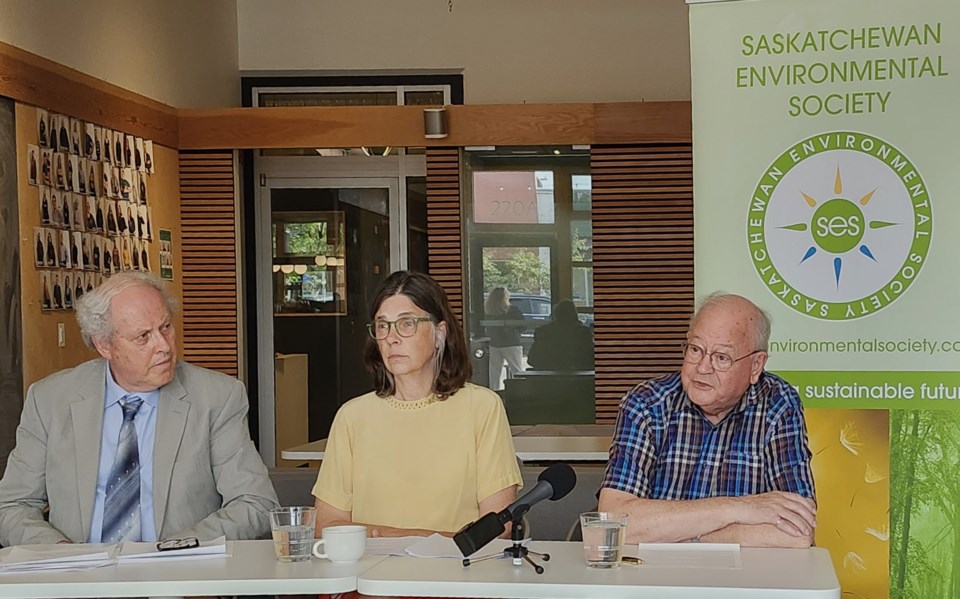
SASKATOON — The Saskatchewan Environmental Society, though disappointed with the ruling of the Court of King’s Bench not to hear their lawsuit against the provincial government’s plan to build new natural gas-fired power stations, said they respected the ruling.
The Court of King’s Bench, last month, ruled not to hear the climate lawsuit filed by several Saskatchewan citizens and Climate Justice Saskatoon against the government’s decision not to proceed in reaching net-zero greenhouse gas emissions.
“We're sorry that the court is basically not going to have the opportunity to receive this expert evidence, which I think could have made a real difference in the case. But now there's an application to strike, basically, the case won't be heard at all,” SES Director Peter Prebble told SaskToday.
He said Sections 110 and 120 of the court’s ruling show that there’s no solid Charter basis for the challenge. The court ruled that the province broke no laws by building the plants and that the Paris Agreement doesn’t legally bind it.
Despite the setback, SES emphasized that the court acknowledged the importance of environmental protection and that the government is not immune from constitutional scrutiny in future climate-related cases.
Prebble, however, said they need to move on and must focus on their legal challenge to the Government of Saskatchewan's decision to keep its coal-fired power stations running, arguing that this will violate federal law, which requires their phase-out by 2030.
The provincial government said it will continue operating coal-fired power stations well beyond the 2030 deadline in federal law for their closure, an issue that raises legal, environmental, and socioeconomic concerns.
Prebble said that the province’s continued reliance on coal is irresponsible and sets a poor global example amid escalating climate crises such as wildfires and ocean damage, adding that they hope to bring Saskatchewan’s situation into focus in every North American jurisdiction.
“It's our view that it's irresponsible to keep these coal-fired power stations running past 2030 because federal law requires every province to phase them out by 2030. The only exception would be the clean coal unit in Estevan. There's a small, clean-coal unit there that meets federal law,” said Prebble,
“All the other coal-fired units in the province would need to be shut down by 2030, but the province is planning to violate this. Coal is the dirtiest form of electricity generation. Coal-fired power generation is the largest source of greenhouse gas emissions.”
He also questioned the feasibility of the government’s alternative plan to replace coal plants with nuclear power stations, including a microreactor project being pursued by the Saskatchewan Research Council, citing their high cost and the potential for massive debt.
“I mean, they [micro reactors] wouldn't generate the 300-megawatt ones, and that's what the provincial government is doing. The problem with these small modular nuclear reactors is their high cost. It's just hard to imagine that. We'd have to build five of these small modular nuclear reactors. I don't know how. It would just be an enormous expense that I worry would bankrupt the SaskPower,” said Prebble.
They will continue pursuing their other case against Saskatchewan’s plan to keep coal-fired power plants operating past 2030, which they argue violates federal law requiring phase-outs by that year. They will again appear in court together with concerned citizens and CPJ on Monday, Nov. 10.