


REGINA — Saskatchewan’s mid-year financial report is projecting a $427 million deficit, a swing of $79 million deeper than the first-quarter forecast and a significant reversal from the $12 million surplus outlined in the budget.
The province says global tariffs, lower oil prices and a weaker outlook in non-renewable resource revenue are putting pressure on the bottom line.
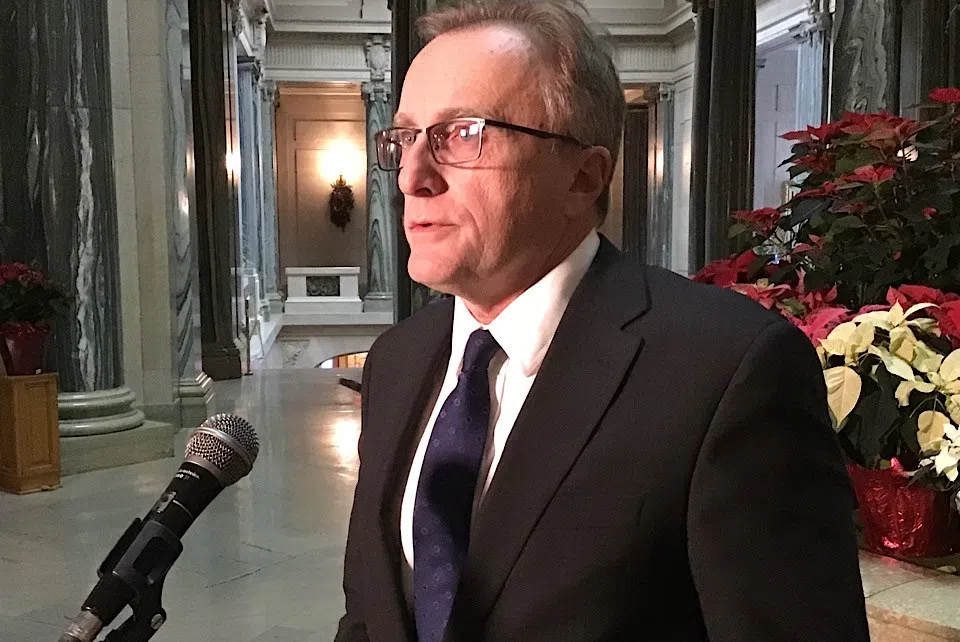
Deputy Premier and Finance Minister Jim Reiter said the mid-year numbers reflect ongoing economic uncertainty, though he noted the province’s exporters remain largely insulated under CUSMA.
“Saskatchewan’s economy remains resilient in the face of global economic uncertainty,” Reiter said. “Our producers have worked hard to find new markets, which has helped Saskatchewan remain in a comparatively strong economic position.”
Total expenses are forecast to rise $521 million, an increase of 2.5 per cent from the budget. The largest pressures include $295 million to cover wildfire costs for the Saskatchewan Public Safety Agency, $250 million to address rising health-care demand and $114 million in pension expenses.
Lower-than-expected crop insurance claims helped offset some increases.
Revenue is expected to increase $82 million, or 0.4 per cent, from the budget. That includes $273 million in federal transfers and $129 million in other own-source revenue driven by population growth, higher fees and gaming revenue.
Those gains are being offset by a $292 million decline in SaskPower’s net income after the federal carbon tax charge was removed from customer bills. Non-renewable resource revenue is expected to fall $93 million due to lower oil prices and a higher exchange rate.
Reiter said the province remains committed to wildfire recovery efforts, managing health-care demand and providing affordability measures.
“Our government is committed to supporting those affected by this year’s unprecedented wildfire season, addressing pressures in health care and providing affordability relief through the income tax reductions contained in the budget,” he said.
Gross debt is forecast at $39.3 billion by fiscal year-end, up $962 million from the budget. Saskatchewan continues to hold the second-lowest net debt-to-GDP ratio in the country.
The government expects GDP to grow 1.7 per cent in 2025, the third-highest projection among provinces. That follows an estimated 3.0 per cent growth rate in 2024, driven by construction, natural resources and agriculture, as well as population and employment increases and strong housing starts.
The Saskatchewan NDP says the mid-year update exposes what it calls a “bogus budget,” arguing the government never had a credible surplus to begin with.
“The Sask. Party’s so-called 12 million surplus was blown on Budget Day before the crowd in the gallery departed to eat cream puffs in the library at the Budget Day Tea,” said NDP finance critic Trent Wotherspoon.
Wotherspoon noted the government is still booking $466.9 million in provincial carbon tax revenue, up $35.4 million since the first quarter, despite promising to eliminate it. Without that revenue, he said, the province’s deficit would approach $900 million.
He also pointed to SaskPower’s projected $166 million net loss — down $292 million from budget — as a sign that “another round of massive rate hikes” could be coming.
“It’s the people of this province who have already had so many taxes stacked on them by this dishonest tax-and-squander government,” Wotherspoon said. “They know it’s them who will be left to foot the bill.”




Comments