

REGINA — The Sask. Party government and the opposition New Democrats continue to be at odds in their interpretations of how the provincial economy is doing.
While the government and Premier Scott Moe continue to tout $62 billion in private investment in 60 projects in the province, including the Bell AI Data Centre near Regina and mining projects up north, this week the NDP has been painting a picture of gloom. This comes especially in the wake of disappointing jobs numbers released last week, with the loss of 6,100 jobs from the previous month.
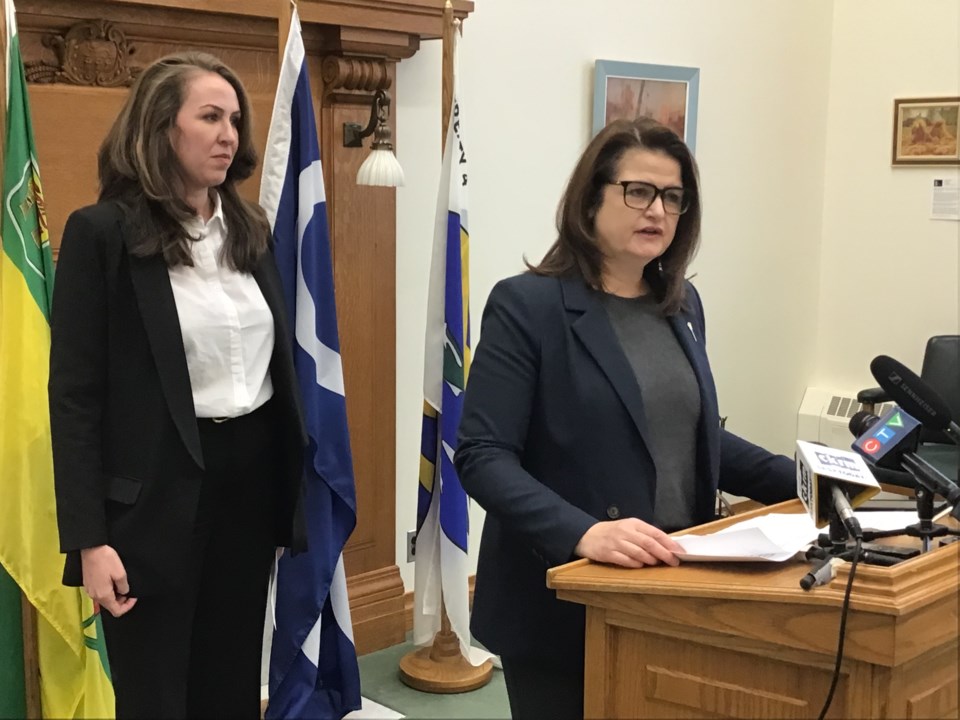
On Thursday at the legislature, Opposition Leader Carla Beck and jobs and economy critic Aleana Young called a news conference where they raised alarm bells about what they saw happening with the Saskatchewan economy.
“We're here today to flag a growing list of economic indicators that confirm what many Saskatchewan people can feel in their pocketbooks. And that is that Saskatchewan's economy is losing momentum and has become increasingly vulnerable to economic downturns,” said Beck.
She said they were seeing retail sales weaken and business numbers continuing to shrink.
“Private sector investment remains far below what we saw just a decade ago. Also alarming is the fact that Saskatchewan's population has seen two quarters of decline. Saskatchewan is losing ground and despite the fact that Saskatchewan people are working harder and harder than ever, people are feeling the impact.”
While Beck acknowledged growth in food, fuel and fertilizer, “we’ve seen a decline in manufacturing.” She also cited a need to train up the labour force in the province.
Beck said it was evident in the province that “we need a new economic development strategy, one that's focused on diversification, attracting investment, leaning into innovation and affordability.”
Young, who pointed to inflation hitting 3.8 per cent in the province, continued to hammer the government on the theme of affordability.
“It's been consistently reported that Saskatchewan people have the highest levels of economic insecurity anywhere in Canada and in recent years we've seen record food bank use and rising levels of homelessness. Families right across Saskatchewan cannot afford to pay for the basic necessities. When affordability declines alongside sluggish economic growth it creates a cycle that is increasingly difficult to break.”
Young also pointed to the first three months of the year, when “we've seen a million barrels less of oil produced in Saskatchewan, and this is at a time when prices are up — that's not a good indicator for this province if we see oil prices going up and production going down.”
“If things are so great, people should be feeling it,” said Beck, pointing to youth unemployment, a lack of purchasing power and the high levels of economic insecurity.
“When the economy is doing well people should be able to feel it in their communities, in their pocketbooks. Their kids should be able to get jobs.”
In response, the government sent out a lengthy statement that ran counter to the NDP narrative.
The statement pointed to Saskatchewan’s unemployment rate of 6.2 per cent, the third-lowest among provinces and below the national average of 6.6 per cent. It also pointed to the province having more than five consecutive years of sustained employment growth and stated the province remains ahead on a year-to-date basis, with 4,900 more people employed from January to May 2026 compared with the same period last year.
The statement also pointed to key gains during this timeframe, with construction adding 2,300 jobs, agriculture adding 1,300 jobs, and forestry, fishing, mining, oil and gas adding 700 jobs. The province also reported that Saskatchewan employers posted 25 per cent more jobs through SaskJobs and the National Job Bank in May 2026 compared with the same month last year.
It pointed to a year-over-year gain of 2,800 jobs among core-aged workers aged 25 to 54 and added that the province is investing $125 million in workforce development programs and services to address the labour challenge.
The province also pointed to gross domestic product at basic prices increasing by 2.2 per cent in 2024, the agriculture industry increasing by 15.2 per cent, and capital investment in Saskatchewan reaching $19.7 billion, up 13.8 per cent from $17.3 billion in 2023. It also pointed to international merchandise exports increasing by 17.8 per cent in April 2026 compared with April 2025 and by 1.7 per cent year to date compared with 2025, ranking third in percentage change among provinces.
On Monday the government issued a news release pointing to more good news in housing starts, manufacturing and wholesale trade.
They reported StatsCan's latest economic reports showed Saskatchewan's manufacturing sales rose 18.8 per cent in April 2026 compared to the same month in 2025, and that wholesale trade rose by 17.9 per cent in the same period, putting Saskatchewan first among provinces for year-over-year growth in wholesale trade and third in manufacturing sales.
They also pointed to Canada Mortgage and Housing Corporation data showing Saskatchewan's urban housing starts increased 50.4 per cent from May 2025 to May 2026, ranking second among provinces. The government also touted April numbers showing the value of manufacturing sales at nearly $2 billion and the value of wholesale trade at $4.9 billion, with housing starts on single family dwellings increasing by 15.9 per cent and multiple units by 72.2 per cent in May 2026.
The focus on the economy by the NDP, and responses by the Sask Party government, come the same week Premier Moe was leading a provincial delegation to Europe on what is described as a trade and investment mission expected to last until June 19.
Moe’s trip to Europe comes immediately on the heels of his stop in Calgary earlier this week at the Global Energy Show Canada. His Europe trip includes Poland, Czechia, Belgium and France, where Moe is attending the Eurosatory 2026 defence show. Moe has previously indicated that potash and energy were expected to be major focuses of the trip.
On Friday came word from the province that Premier Moe had signed a memorandum of understanding with Czechia's First Deputy Minister and Minister of Industry and Trade Karel Havlíček, which the province said in a news release will strengthen the two governments’ relationship through co-operation in trade, energy and innovation.
The province says the MOU includes a special priority on facilitating clean energy solutions such as nuclear energy, small modular reactors, micro modular reactors, renewables, and carbon capture, utilization and storage technologies.
In a statement, Moe said Czechia “shares many priorities with Saskatchewan, and is seeking sustainable energy security for their country.”
“I am excited to see what shared opportunities lie ahead in the areas of sustainable energy, innovation for the nuclear sector and diversifying trade. I look forward to growing this partnership for the benefit of both our economies.”