


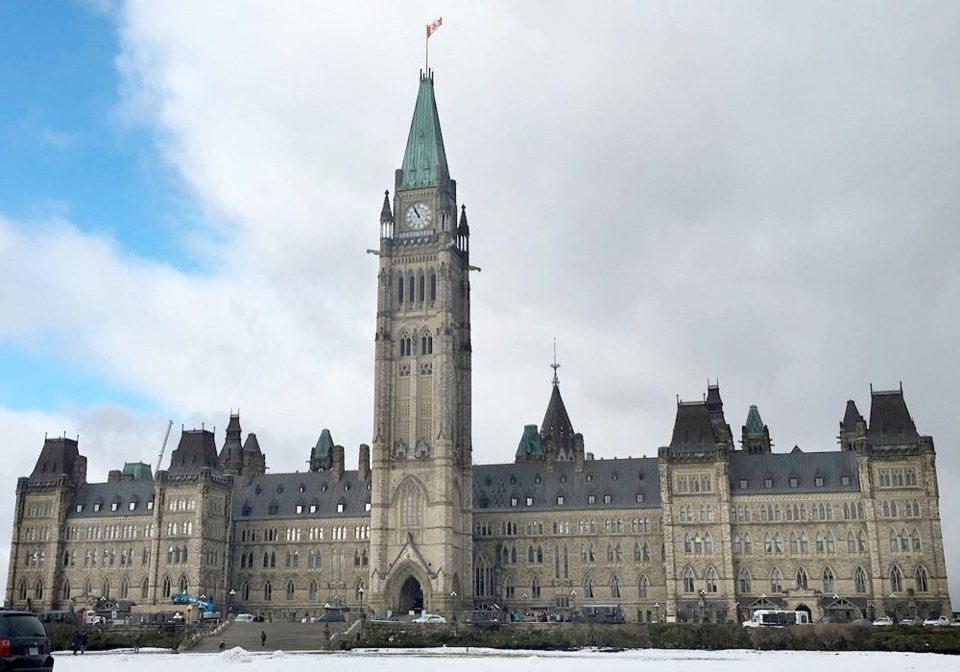
OTTAWA, Ont. — Saskatchewan municipal leaders are back in Ottawa this week, lobbying federal officials once again to come on board with infrastructure funding.
According to the province, Government Relations Minister Eric Schmalz and a number of municipal leaders are in Ottawa, holding meetings with federal officials on that topic.
The delegation, in Ottawa on Oct. 6 and 7, includes representation from Regina, Saskatoon, Moose Jaw, Prince Albert, Swift Current, North Battleford, Yorkton, Weyburn and Lloydminster, as well as from the Saskatchewan Association of Rural Municipalities, Saskatchewan Urban Municipalities Association and Saskatchewan Association of Northern Communities.
"Investing in infrastructure remains a top priority for Saskatchewan's municipalities and we need greater flexibility in the federal government's cost-shared funding programs," Schmalz said in a statement. "Through our Team Saskatchewan approach, we are able to deliver this message directly to Ottawa, supporting the ability of our municipalities to meet the needs of growing communities."
Among those in Ottawa this week was Regina Mayor Chad Bachynski. In a conference call with media from Ottawa, Bachynski noted they had met with the parliamentary secretary to the prime minister, with representation from Housing and Infrastructure, Build Canada Homes, the president of FCM and some of their staff. Bachynski said he also had a one-on-one meeting with the minister of AI and digital innovation, as well as with a couple of Saskatchewan senators, Tracy Muggli and David Arnot.
“It's been a great conversation,” Bachynski said. “I'd say there's an openness to listen and to learn. And Saskatchewan has a very good showing here in Ottawa.”
This latest trip comes one year after a similar trip to Ottawa where lobbying for infrastructure funding was the key topic. Bachynski said there had been some success from last year’s trip.
“So as a result of that trip, that directly impacted us getting the $29 million that we received for the South Trunk project on the west side of the city,” Bachynski said.
The challenge with those direct streams, he said, is that they are 50-50 cost-sharing initiatives with the federal government.
Given that, and “even looking at our debt capacity, for example, what we're looking for is a three-way agreement,” Bachynski said.
“The province has said that they will step up with their third. We obviously are committed to investing our third of any infrastructure project. And so what we're looking for is what we didn't achieve last year, and we're really putting pressure on this year to achieve that three-way agreement with the federal government so that they can put in their third for the infrastructure investment.”
The indication from Bachynski is that a one-third funding model would be more cost-effective for cities to be able to take on major infrastructure projects and address their infrastructure deficits in a timely manner.
“It's challenging already doing it on our own. It's helpful when we can split it 50-50. If we can split it by a third, that obviously gives us more capacity to catch up on the deficit that we have.”
As for infrastructure investments the mayors are seeking funding for, Bachynski said that can “mean everything from an aquatic centre to our underground water pipes and infrastructure.”
“In Regina, we know that our wastewater infrastructure is one of the biggest bottlenecks and barriers to some of our development and growth. In other communities, that may not be the case. But what we're talking about is within our asset management plan, our five-year, 10-year, 20-year plans, we're best positioned to identify what we need in our communities and how to deploy that to make sure that we meet the needs of our growing cities.”
There are some similarities in what the mayors are looking for. Bachynski noted his counterpart in Yorkton, Mayor Aaron Kienle, has “similar needs in terms of our wastewater infrastructure.”
“Other municipalities have their stormwater needs. Some are recreational centres that, again, are city-building initiatives. They maybe aren't thought of as traditional underground infrastructure, but they do provide a livable space for their communities.”
In its news release, the province noted that one issue is that current cost-shared infrastructure programs are smaller and limited in scope compared with programs like the Investing in Canada Infrastructure Program, which saw more than $2 billion flow to 460 municipal infrastructure projects in the province.
The province states that the message the delegation is delivering in Ottawa is that greater flexibility is needed for municipalities seeking cost-shared funding for the various types of infrastructure projects.
A big focus, said Bachynski, is “really around the flexibility.” But another part is about the dollars themselves.
“The current direct stream funding is oversubscribed. So we can see that the need across the country is there,” Bachynski said.
“And so we're also asking not only for the flexibility for municipalities to invest where they need, but also the volume and the quantity of funding to make sure that we can keep up with the growth. Because even now, we've seen in Regina over the last year, we are actually growing even faster than we anticipated one year ago when we approved our growth plan.”