


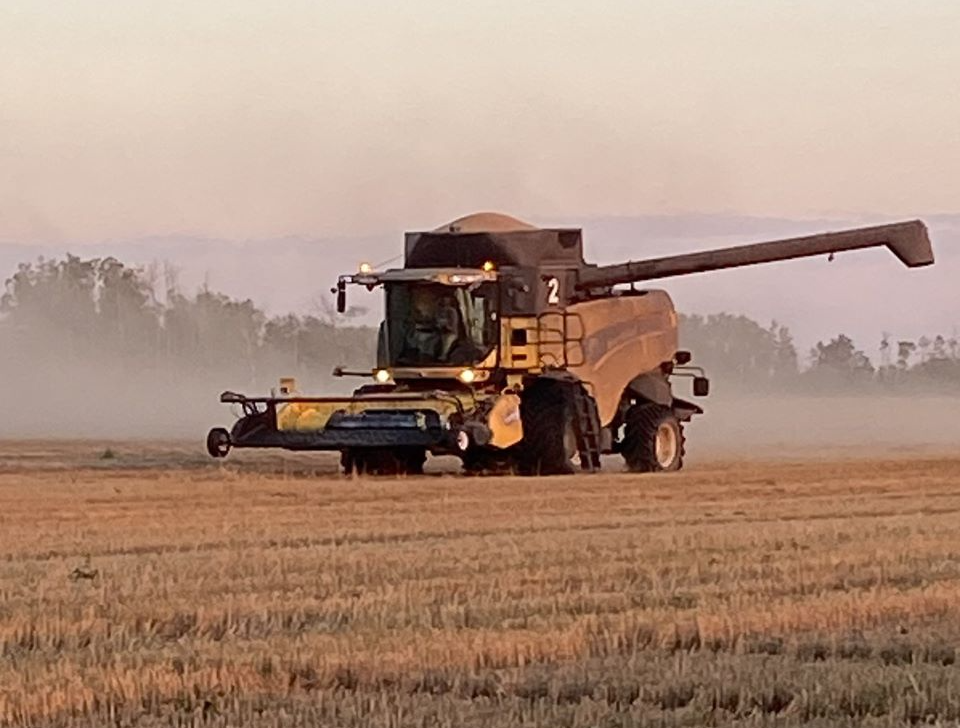
Harvest has wrapped up across Saskatchewan, with 99 per cent complete and only a few acres of later-seeded crops remaining in the field. Despite the challenges experienced this year, crop yields were consistent with 10-year averages and while many crops graded in the top-quality categories, some downgrading did occur due to late-season rain and pest activity.
While most producers were able to finish harvest, rainfall, frost and humid conditions created challenges during the final stages of the season.
Winter cereals and early-seeded pulse crops in southern Saskatchewan were among the first crops to be combined in early August, while many crops in the central and northern regions did not mature until later in the growing season.
Widespread rainfall continued late into the fall, making it difficult to bring in the remaining crop. Wet conditions contributed to lodging in some crops and raised concerns about grain quality, including bleaching and sprouting. Despite these challenges, harvest is now virtually complete across the province. Among the crops still being harvested, progress is 99 per cent complete for canola, 93 per cent complete for flax, 99 per cent complete for soybeans and 97 per cent complete for Canary seed.
Growing conditions varied considerably across Saskatchewan throughout the year. In some areas, excess moisture and flooded fields delayed seeding, with some crops not planted until later in June. Delayed seeding contributed to later crop development and maturity as the growing season progressed. In other areas, timely rainfall supported favourable growing conditions throughout much of the season.
Weather conditions during the summer increased disease risk and many crops were treated with fungicide to help mitigate disease impacts. Crop development progressed well during July, supported by warmer temperatures compared to previous years. As the growing season progressed, crop staging differences became less noticeable in many areas.
Producers also faced localized pest and wildlife pressures during the growing season.
Bertha armyworm and cabbage seedpod weevil were reported in crops, while Richardson's ground squirrel activity created additional challenges in some areas. Despite these pressures, many crops persevered and were able to advance to maturity and harvest.
Timely moisture supported strong yield potential in many areas, while regional precipitation differences and agronomic challenges contributed to variability in yields. Crop yields were generally consistent with the 10-year averages across much of the province this year, with a few crop types yielding above their historical averages.
Cereal yield estimates are:
- 51.9 bushels per acre for hard red spring wheat;
- 44.2 bushels per acre for durum;
- 96.7 bushels per acre for oats;
- 71.2 bushels per acre for barley;
- 49.7 bushels per acre for winter wheat;
- 46.6 bushels per acre for fall rye; and
- 41.2 bushels per acre for triticale.
Pulse crop yield estimates are:
- 37.1 bushels per acre for field peas;
- 1,444.7 pounds per acre for lentils; and
- 1,823.6 pounds per acre for chickpeas.
Oilseed crop yield estimates are:
- 38.3 bushels per acre for canola;
- 26.2 bushels per acre for flax;
- 33.2 bushels per acre for soybeans; and
- 1,018.8 pounds per acre for mustard.
Many crops graded in the top two quality categories, but some downgrading was reported in certain areas due to localized pest activity and late-season rain. Grades for various crop types, from across the province, are provided below:
Canola
- 81 per cent graded as 1 Canada (CAN) compared to 83 per cent for the 10-year average;
- 16 per cent graded as 2 CAN compared to 13 per cent for the 10-year average;
- 2 per cent graded as 3 CAN compared to 3 per cent for the 10-year average; and
- 1 per cent graded as sample, compared to 1 per cent for the 10-year average.
Lentils:
- 25 per cent graded as 1 CAN compared to 31 per cent for the 10-year average;
- 58 per cent graded as 2 CAN compared to 52 per cent for the 10-year average;
- 16 per cent graded as 3 CAN compared to 15 per cent for the 10-year average; and
- 1 per cent graded as sample, compared to 2 per cent for the 10-year average.
Field peas:
- 39 per cent graded as 1 CAN, compared to 42 per cent for the 10-year average;
- 52 per cent graded as 2 CAN, compared to 51 per cent for the 10-year average;
- 8 per cent graded as 3 CAN, compared to 6 per cent for the 10-year average; and
- 1 per cent graded as sample, compared to 1 per cent for the 10-year average.
Durum:
- 25 per cent graded as 1 Canada Western (CW), compared to 39 per cent for the 10-year average;
- 30 per cent graded as 2 CW, compared to 28 per cent for the 10-year average;
- 29 per cent graded as 3 CW, compared to 20 per cent for the 10-year average; and
- 16 per cent graded as other, compared to 13 per cent for the 10-year average.
Barley:
- 16 per cent graded as malt, compared to 31 per cent for the 10-year average;
- 60 per cent graded as 1 CW, compared to 51 per cent for the 10-year average; and
- 24 per cent graded as 2 CW, compared to 18 per cent for the 10-year average.
A full summary of crop grades can be found in the full report.
Producers seeded less winter cereal crops this fall as winter wheat and fall rye acres fell slightly in the province. Compared to last year, seeded acres of winter wheat decreased by three per cent and fall rye decreased by two per cent. The highest drop in fall seeded acres is in the northeast region, while the southwest remains largely unchanged.
Average silage yields in the province this year are 7.45 tons per acre, which is higher than the 5.82 tons per acre reported last year. The southwest reported the highest silage yields, while the lowest yields were reported in the central regions of the province.
Provincially, dryland hay yields are:
- 1.77 tons per acre for alfalfa;
- 1.80 tons per acre for brome hay;
- 1.52 tons per acre for tame hay;
- 1.63 tons per acre for baled forage; and
- 2.51 tons per acre for greenfeed.
The quality of most hay crops was rated as excellent and good, with some small areas reporting poor hay quality. The first cut hay crop was rated as 18 per cent excellent, 71 per cent good, and 11 per cent fair. Producers who were able to complete a second cut reported that 23 per cent was excellent, 47 per cent was good, 22 per cent was fair and eight per cent was poor quality. Hay prices vary throughout the province, but on average, alfalfa is $134.69 per ton, brome is $116.22 per ton, greenfeed is $97.29 per ton, straw is $49.75 per ton and standing hay is $60.56 per ton.
Current topsoil moisture levels vary in the province but, in general, most regions are reported to have sufficient soil moisture as winter begins.
Cropland topsoil moisture is:
- 5 per cent surplus;
- 83 per cent adequate;
- 11 per cent short; and
- 1 per cent very short.
Hayland topsoil moisture is:
- 3 per cent surplus;
- 83 per cent adequate;
- 13 per cent short; and
- 1 per cent very short.
Pasture topsoil moisture is:
- 2 per cent surplus;
- 77 per cent adequate;
- 19 per cent short; and
- 2 per cent very short.
Most pastures across the province are rated in excellent, good or fair condition, with pasture conditions generally reflecting current soil moisture ratings. Overall, pastures are in good condition across Saskatchewan entering winter. Provincially, 10 per cent of pastures are in excellent condition, 63 per cent are in good condition, 23 per cent are in fair condition, three per cent are in poor condition and one per cent are in very poor condition.
With harvest almost complete, only a few producers are still working to bring in crops. Attention has largely shifted to fall field work before freeze-up. Producers are applying post-harvest fertilizer and weed control as needed, with most of this work now complete.
Fall activities continue as grain producers harrow fields, pick rocks and service equipment.
Livestock producers are also busy marketing cattle, moving animals off pasture and hauling bales. Field activity will slow as winter approaches, giving producers time to focus on preparations and planning for the 2027 growing season.
The Saskatchewan Crop Insurance Corporation (SCIC) continues to support producers. Crop Insurance customers are insured for losses in both yield and/or quality. When an insurable cause of loss lowers the grade of harvested production, the quality loss is factored into the claim calculation. Producers can file a post-harvest claim when their actual crop yields or quality fall below their coverage level. A reminder for Crop Insurance customers:
- The deadline to register post-harvest claims, submit production declarations and/or request an extension of insurance is November 15, 2026.
- For 2026, the deadline to pay Crop Insurance premiums without interest is extended to December 31, 2026.
For producers enrolled in AgriStability for the 2026 program year, it's time to begin checking and recording fiscal year-end inventories. The inventory check sheet is available to record year-end information needed to complete 2026 AgriStability forms in the new year.
Find more information at scic.ca.
A complete, printable version of the Crop Report is available online.
Follow the 2026 Crop Report on X at @SKAgriculture.
(Saskatchewan Agriculture news release)




