

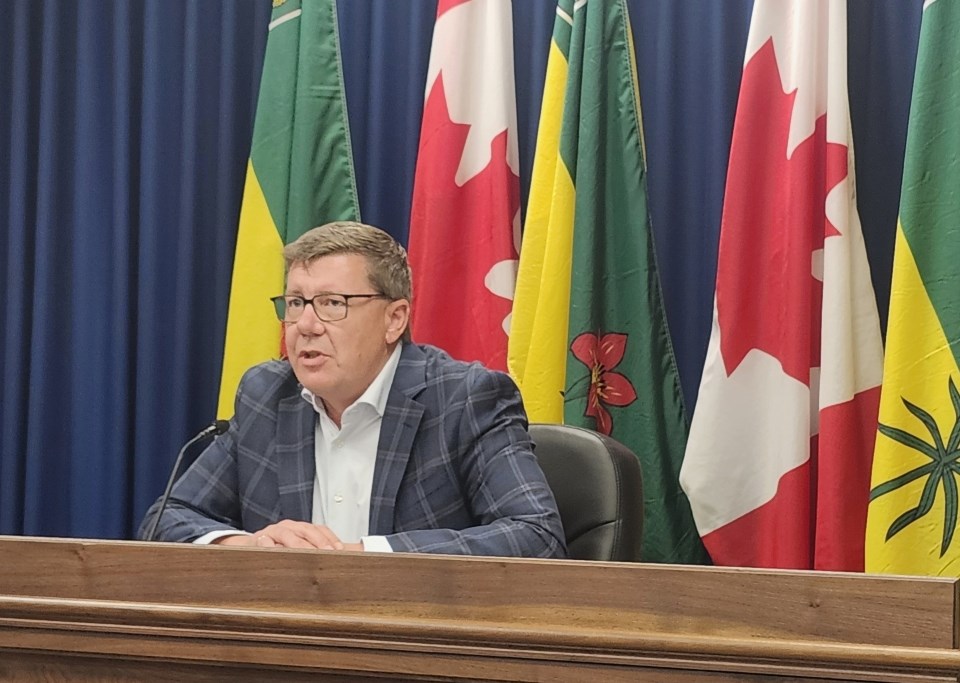
REGINA — Saskatchewan Premier Scott Moe is getting relatively good reviews from the Fraser Institute for his fiscal performance in office.
In a report measuring the fiscal performance of Canada’s premiers titled “Measuring the Fiscal Performance of Canada’s Premiers”, Moe ranks fourth out of the ten provincial premiers with a score of 60.3 out of 100, behind New Brunswick’s Blaine Higgs (who has since been defeated) at 63.8, Ontario’s Doug Ford at 64.5, and at the top Alberta’s Danielle Smith at 75.6.
Trailing behind Moe were Quebec’s Francois Legault, PEI’s Dennis King (who also has left office), Nova Scotia’s Tim Houston, David Eby of BC, Andrew Furey of Newfoundland and Labrador (who has also left office) and at the bottom Manitoba’s Wab Kinew at 31.1.
The premiers are measured based on the time from when they first held office to the end of the fiscal year in which data is available.
Premiers were also ranked based on their government spending performance, measures by the annual difference between program spending growth and provincial economic growth. On this measure Ford was first at 83.2, followed by Eby at 80.8 and then Moe at 69.6. Kinew ranked dead last with a score of 10.9.
On taxes, Moe was in the bottom half at 51.3, with Smith scoring at the top at 79.4 followed by Legault at 67.9 and Eby at 63.
For corporate income tax Legault was on top at 83.1 compared to 78.2 for Smith, with Moe second last at 29.4, only ahead of PEI’s King. Moe fared much better for personal income tax at 73.1, only behind Smith at 80.6.
On deficits and debt, the Fraser Institute tracked the deficits and surpluses as a percentage of GDP and found Moe ranked fifth at 60.0, with Smith on top with a perfect score of 100. Eby ranked last at zero.
On the findings
Jake Fuss, Director of Fiscal Studies for the Fraser Institute, was author of the study. He said that the focus was on premiers’ performance on government spending, taxes, and then their performance on deficits and debts up to the end of the 2024-25 fiscal year.
“So we’re looking at actual data rather than projections. And ultimately, what we’re looking at here is that premiers who manage spending a lot more prudently, who balance their budgets and pay down debt while maintaining or reducing tax rates are going to rank higher than premiers that don’t do those things.”
In terms of the rankings, Fuss said Smith scored performed the highest when it comes to taxes and deficits and debt. “She scored a lot lower among government spending, but the top ranking for taxes and deficits and debt were ultimately enough to make her the number one premier in the rankings. And this is primarily because she’s maintaining some of the lowest tax rates in the country when it comes to business and personal income taxes, as well as consistently running surpluses throughout most of her tenure and reducing the overall debt load as a share of GDP. And similar for other premiers who rank high in the rankings, whereas if we look at some of the lower-ranking premiers, for instance, they’re generally increasing debts, either maintaining high tax rates or increasing taxes, and then spending at very high rates.”
With only a short time in office so far as Premier, Manitoba’s Kinew ranked at the bottom.
“This is obviously a small sample size so far, because it’s only one year of analysis that we have,” said Fuss. “But he ranked dead last when it came to government spending, so he’s increasing spending quite rapidly. He’s ranking fairly well when it comes to taxes at fourth overall, largely due to Manitoba’s lower tax rates than some other jurisdictions. But when it comes to deficits and debts, again, he’s second last among the premiers right now, as he’s run a fairly large deficit and is currently increasing the debt load for the province. So overall, those are kind of the main reasons why he’s in last place.
As for Moe, Fuss said he’s “kind of in the middle of the pack, and I think that’s pretty consistent across the board if we look at our three different categories.”
“So he actually ranks fairly well when it comes to government spending. He’s third out of the ten premiers when it comes to that category, so he’s been relatively restrained on spending there. And then if we look at the tax category, he ranks, again, in the middle of the pack at sixth. And then lastly, on the deficits and debt, he ranks fifth, so basically squarely in the middle on a lot of these categories. And that’s largely due to him running some smaller deficits than some other Premiers, but also not running the same level of surpluses that other premiers like Danielle Smith have been running. So that’s largely the main reasons why he’s kind of middle of the pack, better than a lot of the Eastern premiers in particular, but also not quite as good as some of the top-ranking premiers currently.”
Overall, Fuss said the message of the report is that “all of the premiers have room for improvements.”
“And given the importance of sound fiscal policy, I think it’s really crucial that they look to prioritize restraint and spending, they look to balance their budgets, they look to lower their debt levels and establish a more competitive provincial tax system. If they do those things, not only are they going to score well in these rankings, they’re also going to set up their province for future economic success and ultimately set the direction of their government for years to come.”